
Container gantry cranes operating in extreme cold regions face structural challenges far beyond those encountered in temperate climates. Ports, logistics hubs, and industrial terminals in northern Russia, Scandinavia, Canada, and other subarctic or Arctic regions must contend with prolonged low temperatures, thermal cycling, snow and ice accumulation, strong winds, and reduced material toughness. In such environments, structural design becomes a critical determinant of safety, reliability, and service life.
This article explores the key structural design principles, material considerations, and engineering strategies required to ensure container handling gantry cranes perform safely and efficiently in extreme cold regions.
1. Environmental Challenges in Extreme Cold Regions
Extreme cold environments typically involve ambient temperatures ranging from -20°C down to -40°C or lower, often sustained over long periods. These conditions impose multiple structural risks:
-
Reduced steel toughness, increasing the risk of brittle fracture
-
Thermal contraction, leading to internal stress accumulation
-
Freeze–thaw cycles, accelerating fatigue and microcrack propagation
-
Snow and ice loads, adding unexpected static and dynamic loads
-
High wind speeds, often amplified in open port areas
Structural design must therefore consider not only rated lifting loads but also environmental load combinations that are more severe and persistent than standard operating conditions.
2. Material Selection for Low-Temperature Structural Safety
2.1 Importance of Low-Temperature Steel
One of the most critical aspects of cold-region gantry crane design is structural material selection. Conventional carbon structural steels may experience a sharp reduction in impact toughness at low temperatures, leading to brittle failure without warning.
To mitigate this risk, designers typically specify low-temperature structural steels, such as:
-
Q355E / Q355D (GB standards)
-
S355NL / S355ML (EN standards)
-
ASTM A572 Grade 50 with low-temperature impact requirements
These materials maintain adequate Charpy V-notch impact energy at sub-zero temperatures, ensuring ductile behavior under dynamic and shock loads.
2.2 Weldability and Fracture Resistance
In cold climates, welded joints often become the weakest points in a gantry crane structure. Structural design must therefore ensure:
-
Controlled carbon equivalent (CE) to reduce cold cracking risk
-
Use of low-hydrogen welding consumables
-
Increased weld throat thickness and smooth transition zones
-
Avoidance of sharp stress concentrators near welds
Fracture mechanics analysis is often applied to critical joints in main girders, legs, and portal frames to prevent crack initiation and propagation.
3. Structural Configuration and Load Path Design
3.1 Main Girder Design Under Low-Temperature Conditions
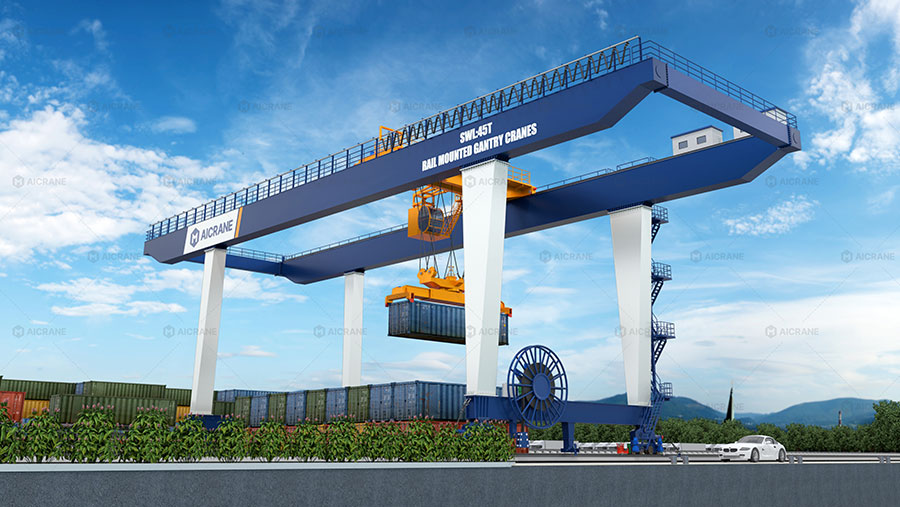
Container gantry cranes typically adopt box girder structures for main beams due to their high torsional rigidity and fatigue resistance. In extreme cold regions, girder design must account for:
-
Thermal contraction effects along long spans
-
Increased stiffness to limit deflection under combined wind and ice loads
-
Optimized diaphragm spacing to prevent local buckling
Designers often increase plate thickness marginally to improve fracture resistance while balancing weight and cost.
3.2 Portal Frame and Leg Structure Optimization
The portal frame and supporting legs experience complex combined loads, including vertical lifting loads, lateral wind forces, braking forces, and thermal stresses. In cold-region designs:
-
A-frame or reinforced U-frame legs are preferred for better load distribution
-
Leg cross-sections are designed to reduce stress concentration at knee joints
-
Structural continuity is emphasized to minimize abrupt stiffness changes
Special attention is paid to the leg-to-girder connection, which is highly sensitive to temperature-induced stress.
4. Thermal Stress and Structural Deformation Control
4.1 Effects of Thermal Contraction
At temperatures below –30°C, steel structures can experience noticeable dimensional contraction. In large gantry cranes with spans exceeding 30–40 meters, this contraction can introduce significant internal stress if not properly accommodated.
Structural design strategies include:
-
Allowing controlled movement through expansion joints or sliding bearings
-
Designing rail alignment tolerances for thermal shrinkage
-
Avoiding over-constrained structural connections
4.2 Camber and Alignment Design
Camber design must consider both operational deflection and temperature-related deformation. Improper camber settings may lead to uneven wheel loads or rail misalignment during cold operation, accelerating wear and increasing structural stress.
5. Wind, Ice, and Snow Load Considerations
5.1 Enhanced Wind Load Design
Cold-region ports often experience strong seasonal winds, sometimes combined with snowstorms. Structural design standards typically require:
-
Increased wind pressure coefficients
-
Consideration of wind acting on ice-covered structural surfaces
-
Stability verification under out-of-service storm conditions
The crane structure must maintain stability even when parked, with wind loads acting on a fully exposed frame.
5.2 Snow and Ice Accumulation Loads
Snow and ice accumulation can add significant dead load, particularly on:
-
Main girder top plates
-
Walkways and platforms
-
Cable trays and auxiliary structures
Designers often apply additional load allowances or require sloped surfaces and drainage paths to reduce accumulation.
6. Fatigue Design Under Cold Climate Operation
6.1 Low-Temperature Fatigue Behavior
Cold temperatures can reduce the fatigue endurance of steel, especially at welded joints. Container gantry cranes in cold regions often operate with frequent start-stop cycles, increasing fatigue damage accumulation.
Structural fatigue design includes:
-
Higher fatigue safety factors
-
Improved weld detail categories
-
Smoother geometry transitions at stress concentration points
6.2 Long-Term Structural Durability
To ensure long service life, designers may apply finite element method (FEM) analysis to simulate stress ranges under combined lifting, wind, and thermal loads. This allows identification of critical fatigue zones early in the design phase.
7. Standards and Design Codes for Cold-Region Cranes
Structural design of container gantry cranes in extreme cold regions typically follows a combination of international and regional standards, including:
-
ISO 8686 (loads and load combinations)
-
FEM standards for crane structural classification
-
EN 1993 (Eurocode 3) with low-temperature steel provisions
-
GB/T crane design codes with cold-climate supplements
In many projects, additional project-specific technical specifications are introduced to address local environmental conditions.
8. Design for Maintenance and Inspection in Cold Environments
Structural design must also consider maintainability, as inspection and repair are more difficult in freezing conditions. Key considerations include:
-
Accessible inspection points for critical welds
-
Protective coatings compatible with low temperatures
-
Structural layouts that reduce ice-trap zones
Designing for ease of inspection helps ensure early detection of fatigue cracks or corrosion-related damage.
9. Future Trends in Cold-Region Gantry Crane Structural Design
With the expansion of logistics and energy projects in northern regions, cold-climate container gantry cranes for ports are increasingly adopting:
-
Advanced low-temperature steel grades
-
Structural health monitoring sensors embedded in key load-bearing members
-
Digital twin models for predictive structural maintenance
These innovations further enhance safety, reliability, and lifecycle performance.
Conclusion
The structural design of container gantry cranes in extreme cold regions requires a comprehensive engineering approach that integrates material science, load analysis, fatigue design, and environmental adaptation. By selecting appropriate low-temperature materials, optimizing structural configurations, accounting for thermal and environmental loads, and adhering to rigorous design standards, engineers can ensure safe and reliable crane operation even in the harshest climates.
Well-designed cold-region container gantry cranes are not only structurally robust but also economically efficient, offering long-term performance and reduced lifecycle risk in some of the world’s most demanding operating environments.