
The wind energy sector is currently defined by a singular trend: gigantism. As turbine manufacturers strive for higher efficiency and greater power output, wind turbine blades have grown from 40 meters to well over 100 meters in length. These aerodynamic marvels are not just long; they are incredibly fragile, expensive, and difficult to maneuver.
In the storage yards of manufacturing hubs and deployment ports, the traditional methods of moving these “super-loads”—using tandem truck cranes or specialized trailers—are increasingly reaching their limits. The industry is rapidly shifting toward the Industrial Rubber Tyred Gantry Crane as the gold standard for blade logistics. This article explores how the RTG has mastered the delicate art of handling the world’s longest composite structures.
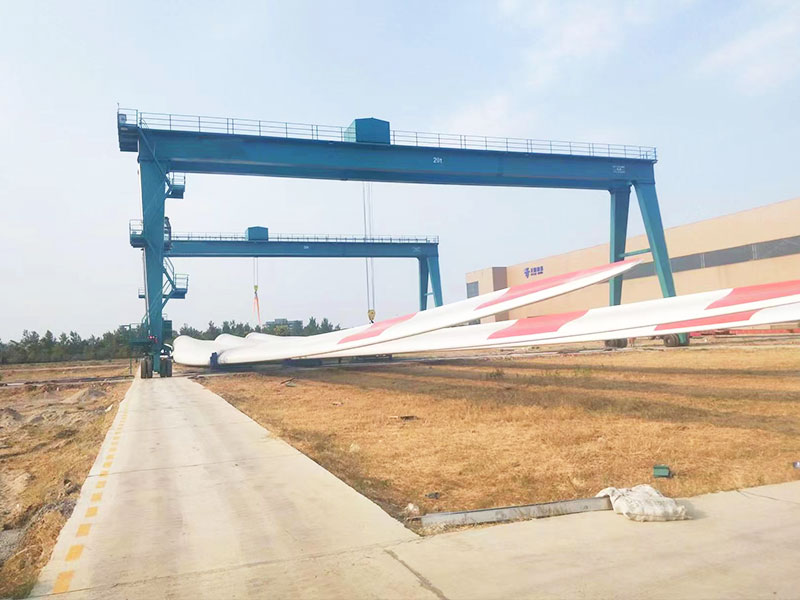
The Logistical Nightmare of the Modern Wind Blade
To understand the value of an RTG, one must first understand the “cargo.” A modern offshore wind blade can exceed 100 meters—longer than a football field—yet it is essentially a hollow shell of fiberglass and balsa wood.
-
Flexibility vs. Fragility: Despite their strength in the air, blades are susceptible to structural damage if lifted incorrectly. Uneven pressure or excessive “bending” during a lift can cause internal delamination.
-
Surface Sensitivity: The aerodynamic finish is critical. Any scratch or dent can lead to turbulence and reduced energy yield over the turbine’s life.
-
The “Sail” Effect: Due to their shape, blades act as massive sails. Even a moderate breeze can turn a 50-ton blade into an uncontrollable force if the lifting equipment lacks precision.
1. The Stability of the Dual-Gantry Lift
While a single heavy-lift crane struggles with the extreme length of a blade, the RTG approach utilizes a “straddle” philosophy. In most advanced wind yards, either a single wide-span RTG or a pair of synchronized RTGs are used to handle the load.
Unlike a truck crane with a single pivot point (the hook), an RTG mobile gantry crane provides a wide, stable frame. When a blade is lifted by an RTG, the center of gravity is maintained between the crane’s vertical legs. This eliminates the “tipping” risks associated with boom cranes and allows for a much smoother vertical lift. For ultra-long blades, two RTGs can work in tandem, digitally “locked” to ensure they move at the exact same speed and height, preventing any twisting or stress on the blade’s root or tip.
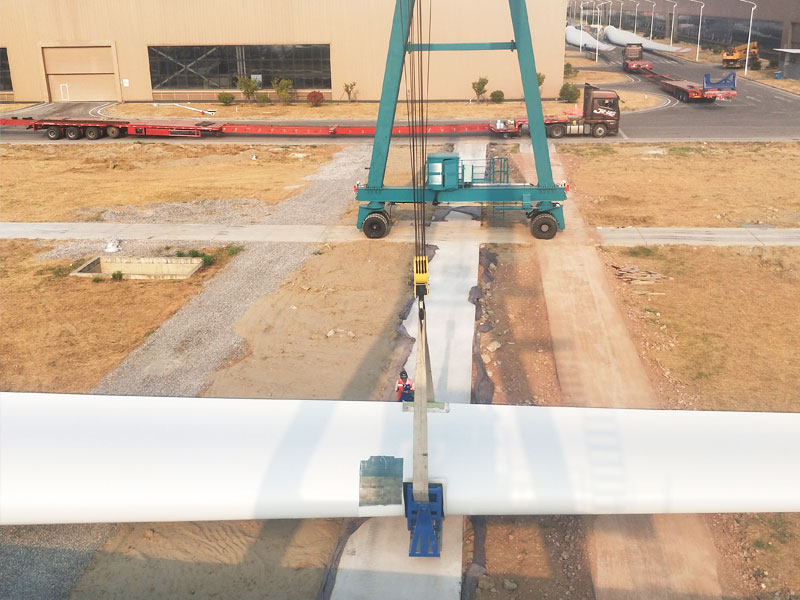
2. Advanced Spreader Beams and Soft-Attachment Tech
An RTG is only as good as its interface with the blade. In wind logistics, the RTG is equipped with specialized Blade Spreader Beams.
These beams feature multiple attachment points that grip the blade at the “Root” (the heavy, circular base) and the “Mid-section” (the aerodynamic body).
-
The Root Fixation: The root is the strongest part of the blade. The RTG uses a hydraulic clamp or a bolt-on frame to secure this end.
-
The Sling/Vacuum Support: For the mid-section, industrial gantry cranes often employ wide, padded slings or even specialized vacuum suction pads that distribute the lifting force over a large surface area, ensuring no “point-loading” damages the composite skin.
3. “No-Turn” Maneuverability: The 90-Degree Advantage
Storage yards are expensive. Maximizing the number of blades stored per square meter is a top priority for terminal operators. Traditional transport involves long trailers that require massive turning radii—often leaving vast amounts of “dead space” in the yard.
RTG cranes revolutionize yard density through Multi-Directional Steering:
-
Transverse Travel: An RTG can lift a blade from a production line and move it 90 degrees sideways. This allows blades to be stacked side-by-side in tight “ribbon” formations, with only a few meters between rows.
-
Carrousel Mode: The RTG can rotate the blade 360 degrees within its own footprint. This is essential for orienting blades for final loading onto sea-going vessels or specialized rail cars.
-
Crab Steering: For fine-tuning the placement of a blade onto its storage “stools,” the RTG can move diagonally, providing a level of precision that a truck-and-trailer combo simply cannot match.
4. Mitigating Wind Risk with Anti-Sway System
In coastal storage yards, wind is a constant factor. When a 100-meter blade is suspended in the air, it is highly sensitive to gusts.
Modern RTGs designed for wind yards are equipped with Electronic Anti-Sway Systems. Using laser sensors and encoders, the crane’s control system detects the onset of oscillation. The system then automatically micro-adjusts the trolley and gantry movements to cancel out the sway. This allows operations to continue safely in wind speeds that would force traditional cranes to shut down, significantly increasing the “operational window” of the port.
5. Precision Placement and Digital Twin Integration
Placing a wind blade onto its transport frame or storage stool requires millimeter precision. The root bolts must align perfectly with the frame’s receptors.
Industrial RTGs utilize Inching Controls and Vision Systems. High-definition cameras mounted on the spreader beam allow the operator (who may be in a remote office or an elevated cabin) to see the exact alignment of the bolts.
Furthermore, these cranes are increasingly integrated into the yard’s Management System (WMS). As the RTG picks up a blade, it automatically records the blade’s serial number (via RFID or OCR) and its exact GPS coordinates in the yard. This creates a “Digital Twin” of the storage area, ensuring that no blade is ever “lost” in the sea of white fiberglass.
6. Sustainable Operations: The Rise of the E-RTG
As the wind industry is fundamentally about “Green Energy,” there is a growing push for “Green Logistics.” Traditionally, yard equipment was powered by massive diesel engines. Today, the Electric RTG (E-RTG) is taking over.
-
Battery and Cable Reel: Many wind yards are now equipped with “Busbar” or cable reel systems that allow the RTG to run on pure electricity.
-
Energy Regeneration: When an RTG lowers a 50-ton blade from a high stack, the electric motors act as generators, capturing the energy and feeding it back into the grid or the crane’s battery pack.
-
Zero Emissions: This is particularly important for indoor manufacturing facilities where diesel exhaust would require expensive ventilation systems.
7. Safety: Protecting High-Value Assets and Personnel
The financial consequences of dropping or damaging a wind blade are staggering—not just in the cost of the blade (which can run into millions), but in the delay to the wind farm’s commissioning.
The RTG enhances safety through:
-
Redundant Hoisting: Double-rope systems ensure that if one cable fails, the load remains secure.
-
Overload Protection: Sensors prevent the crane from lifting if the weight distribution is uneven or exceeds safe limits.
-
Operator Ergonomics: Elevated cabins with floor-to-ceiling glass provide a clear view of the entire blade length, reducing the reliance on ground-based signalmen who may be in the “danger zone.”
Conclusion: The Backbone of the Energy Transition
The transition to renewable energy depends on our ability to build bigger and move faster. The Rubber Tyred Gantry crane has proven to be the “missing link” in the wind energy supply chain. By providing the stability of a bridge crane with the flexibility of a mobile vehicle, it allows storage yards to operate with higher density, better safety, and lower costs.
As we look toward the next generation of 15MW and 20MW turbines, the RTG will remain the backbone of wind logistics—turning the impossible task of moving 120-meter “sails” into a routine, precision operation.
Comparison: Blade Handling Methods
| Feature | Truck Crane (Tandem) | Specialized Trailer | Industrial RTG |
| Yard Density | Low (Needs outrigger space) | Medium (Needs turning space) | High (Sideways movement) |
| Precision | Medium | Low | Excellent (Anti-sway) |
| Safety | High Risk (Tandem coordination) | Medium | High (Integrated control) |
| Pick-and-Carry | No | Yes | Yes (Full load mobility) |