
The self loading concrete mixer has long been the workhorse of remote and constrained construction sites. Its ability to batch, mix, and transport concrete in a single, self-contained unit has made it indispensable. However, the industry has often accepted certain limitations as inherent to the design: modest payloads, inevitable spillage during loading, and a hard ceiling on production throughput. These constraints have been accepted as the “cost of doing business” in challenging environments. But the paradigm is shifting. A new generation of self loading concrete mixers is emerging, engineered to challenge these assumptions. This is a machine designed to load bigger volumes, eliminate material loss, and dramatically increase production rates. It represents a fundamental recalibration of what a contractor can expect from a mobile concrete mixer, setting a new standard for efficiency and productivity.
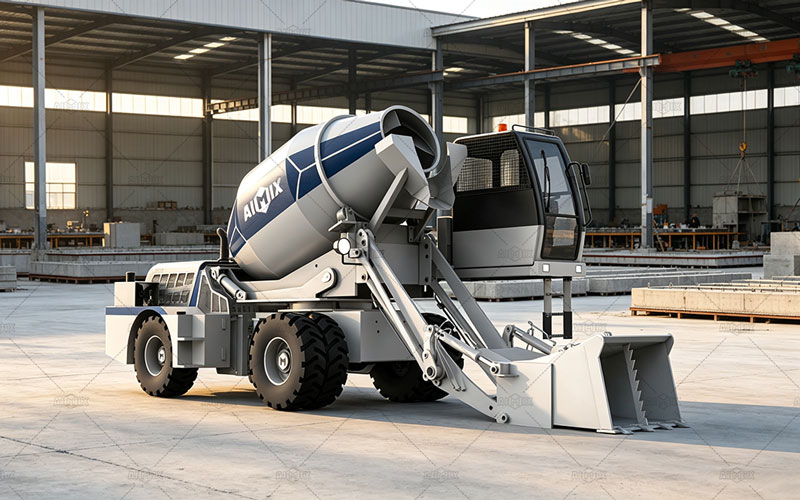
1. The Geometry of Loading: Maximizing the Payload
The capacity of a self loading mixer is a function of the drum’s volume and the effectiveness of the loading mechanism. Traditional designs often underutilized the drum’s potential due to spillage or inefficient filling.
Re-Evaluating the Charging Bucket Design
Conventional self loading concrete mixers often feature a charging bucket that is restricted in its reach and angle of rotation. This forces the operator to position the machine with millimeter precision to fill the bucket, often resulting in an incomplete scoop or the need for multiple, time-consuming loading cycles. The new standard incorporates a high-torque, long-reach hydraulic arm that allows the bucket to be placed precisely within the aggregate pile, ensuring a full, heaped scoop on every cycle. This larger bucket capacity, coupled with a reinforced pivot mechanism, allows the machine to load its own drum to its maximum volumetric capacity in fewer cycles, reducing the total loading time and increasing the effective throughput per hour.
Optimization of Drum Geometry and Fill Angle
The shape of the mixing drum has been re-engineered to accommodate a higher fill volume without compromising the mixing action or causing the mix to spill during transport. By adjusting the drum’s angle of repose and the internal flighting configuration, manufacturers have increased the “useful” volume of the drum. This allows for a larger payload per trip, meaning the machine makes fewer journeys to the pour point. This reduces fuel consumption, lowers wear on the undercarriage, and, most importantly, accelerates the overall pour schedule.
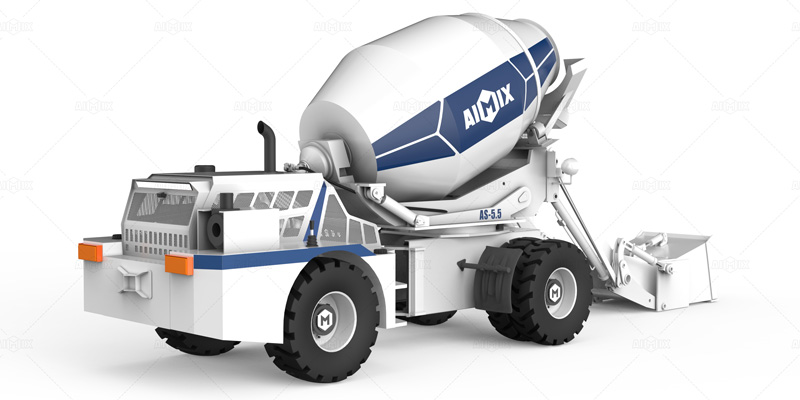
2. Minimizing Material Loss: The Spillage Problem
Spillage during the loading and transport phases of a concrete pour is a silent profit killer. It represents wasted raw materials, requires costly cleanup, and creates a hazardous site environment.
Advanced Drip Trays and Splash Guards
The most obvious source of spillage is the gap between the charging bucket and the drum’s opening. The new generation of mini concrete mixers employs an integrated, hydraulically-actuated splash guard that deploys the moment the bucket tips. This guard forms a seal over the drum opening, preventing any material from splashing out during the final pour of the bucket. Furthermore, an enlarged, self-cleaning drip tray is positioned beneath the charging area. This tray captures any aggregate or cement dust that escapes during loading, preventing it from accumulating on the site and allowing the operator to easily re-scoop the material back into the drum.
On-Board Water Injection for Dust Suppression
Cement dust escaping during loading is not only a waste of expensive binder but also an environmental and health hazard. The new standard incorporates a precision water misting system that injects a fine spray of water into the drum opening during the loading process. This suppresses the fugitive dust before it can become airborne. The water quantity is calculated to be part of the mix’s water-cement ratio, ensuring that the dust suppression does not alter the concrete’s designed slump. This not only recovers valuable material but also contributes to a safer, cleaner work environment.
The combination of larger payloads and reduced spillage cascades into a significant improvement in the overall production cycle. The result is a machine that can produce more cubic meters of concrete in a working day.
Reduction in Cycle Times and Fuel Consumption
A larger capacity per load means fewer trips to the stockpile and back to the pour. This reduction in the number of cycles directly reduces the large concrete mixer machine‘s operational fuel consumption. It also reduces the wear on the drive train and the hydraulic system. For the contractor, this means lower operating costs and a longer lifespan for the equipment. The time saved per pour can be significant, allowing the crew to focus on skilled finishing work rather than logistics.
Improving the Quality of the Mix
Spillage is not just a quantity issue; it is a quality issue. When the batching ratio is distorted by spilled material, the water-cement ratio of the remaining mix changes. This can result in a batch that is too dry or too wet, compromising the structural integrity of the pour. By preventing spillage and ensuring all the batched material enters the drum, the new standard mixers guarantee that the designed mix consistency is preserved. This results in a higher quality concrete with a predictable compressive strength, reducing the risk of costly structural failures.
Economic Impact and Return on Investment
The higher upfront cost of these advanced mixers is rapidly offset by the increased productivity and reduced material wastage. A machine that loads faster, spills less, and produces more concrete per day provides a faster return on investment. It allows a contractor to take on larger projects with the same fleet, or to complete existing projects in a shorter timeframe, freeing up capital for new ventures. This is not merely an incremental improvement; it is a new standard that redefines the economics of mobile concrete production.